Authors / metadata
DOI: 10.36205/trocar6.vid25013
Abstract
Background: Losing a needle during Laparoscopic surgeries presents a significant challenge due to the limited visual field, small size of the needle and potential risk for complications.
Objective: To demonstrate the use of a hysteroscope as an alternative way to retrieve a lost needle at the port site during laparoscopic surgery.
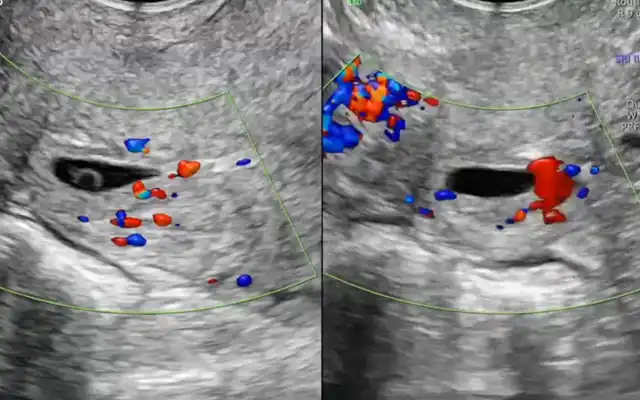
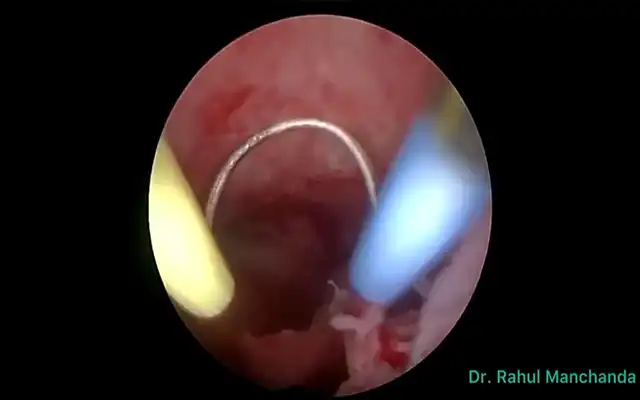
Materials and Methods: A 34-year-old woman, with two previous caesarean deliveries, had severe dysmenorrhea and heavy menstrual bleeding. Ultrasonography was suggestive of a posterior wall adenomyoma of 5 cm. She did not respond to medical management, hence a laparoscopic adeno-myomectomy was planned. During the retrieval from the lateral port, the needle was lost. An hysteroscope with CO2 insufflation was introduced through the port wound, and the needle was seen lying within the abdominal wall layers. A 5 Fr hysteroscopic grasper was introduced into the operative channel of the hysteroscope, and the needle was held with it. The whole assembly was then withdrawn together from the port site under vision.
Results: A 30-degree 5 mm Operative hysteroscope was successfully used to retrieve the lost needle in our case from the abdominal wall layers at the port site wound. The patient was discharged in good clinical condition. No post-operative complications were encountered.
Conclusion: A 5 mm operative hysteroscope with CO2 insufflation can be an alternative addition to the armamentarium to find a lost needle at the port site in Laparoscopic Surgeries.
Introduction
Needle loss during minimally invasive surgeries is rare but significant. Reported incidence ranges from 0.06% to 0.11% (1). Factors contributing to needle loss include high body mass index, multiple surgical teams, equipment failure, inadequate communication among surgical team members, and the complexity and duration of the surgery (2). While the occurrence is uncommon, it poses challenges due to potential patient injury, prolonged operative time, and medicolegal implications.
Aim: The aim of this article is to present a unique and effective technique for retrieving a lost needle during laparoscopic surgery using a 5 mm operative hysteroscope. By sharing this case the aim is to demonstrate an alternative approach that is safe, minimally invasive, and practical, especially in situations where conventional retrieval methods are unsuccessful.
Value: This video highlights an alternative, minimally invasive approach to retrieving a lost needle during laparoscopic surgery using a 5 mm operative hysteroscope. The visual format allows for clear demonstration of a technique not commonly described in literature, showcasing adaptability and the use of readily available instruments. It serves as a practical educational tool for surgeons facing similar intraoperative challenges.
Material and methods
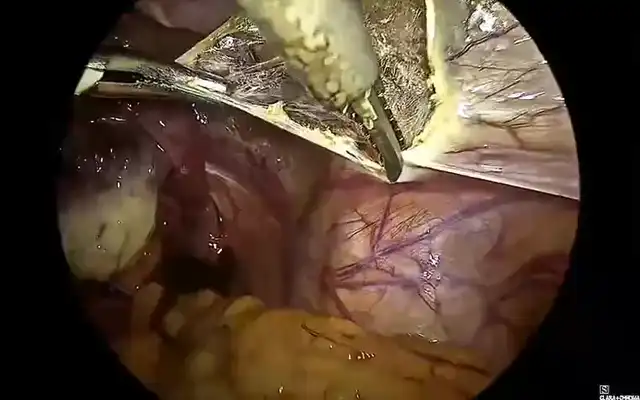
A 34-year-old woman, with previous two caesarean deliveries, had severe dysmenorrhea and heavy menstrual bleeding. Ultrasonography was suggestive of posterior wall adenomyoma of 5 cm. She did not respond to medical management, hence laparoscopic adenomyomectomy was planned. After excision of the adenomyoma, the myometrium was repaired in 2 layers using No. 1-0 polydioxanone barbed suture. The needle was lost during retrieval from the 5 mm lateral port. A systematic search of the abdomen for the needle was performed. Simultaneously, a re-play of the surgical video was done. A decision was made for intraoperative X-ray examination. In the meantime, it was decided to use a 30-degree 5 mm operative hysteroscope. The assembled hysteroscope was attached to the laparoscopic CO2 gas tubing and introduced into the trocar wound, we saw the needle with the thread attached in the abdominal layers. It was possible to successfully retrieve the needle with the help of hysteroscopic grasper. The patient included in this video gave consent for publication of the video and posting of the video online including social media, the journal website, scientific literature websites (such as PubMed, ScienceDirect, Scopus, etc.) and other applicable sites.
Results
A 30-degree 5 mm Operative hysteroscope was successfully used to retrieve the lost needle in our case from the abdominal wall layers at the port site wound. The patient was discharged in good clinical condition. We did not encounter any post-operative complications.
Discussion
The loss of a needle during laparoscopic surgery is uncommon but significant (3). It is a complication that can extend operative time, increase the risk of injury to surrounding structures, and pose medicolegal concerns (4, 5). Despite advancements in laparoscopic instruments and techniques, the retrieval of lost needles remains a challenging scenario, particularly when the needle becomes embedded within the abdominal wall layers or deeper tissues (6). Traditional methods for retrieving lost needles include systematic visual inspection, laparoscopic exploration, and the use of specialized retrieval instruments such as laparoscopic magnets, graspers, and even intraoperative radiography in certain cases (7,8). However, these approaches can be time-consuming, particularly if the needle migrates into the abdominal wall layers or fascia, making it difficult to locate and retrieve without additional incisions. In this case, the needle was embedded within the abdominal wall layers, not easily accessible through conventional laparoscopic instruments. The limited visual field and confined space of the port site further complicated the retrieval process. The introduction of a 5 mm operative hysteroscope into the port site provided a direct visual pathway to identify the lost needle within the abdominal wall layers. The hysteroscope’s 30- degree viewing angle facilitated enhanced visualization of the needle’s location, allowing precise manipulation and retrieval (9). The use of CO₂ insufflation provided the necessary pneumoperitoneum, ensuring adequate working space while minimizing the risk of injury to surrounding structures during the retrieval process (10). The use of a 5 Fr hysteroscopic grasper through the operative channel proved effective in securely grasping the needle without causing additional tissue damage.
Video
Conclusion
This case illustrates the potential of a 5 mm operative hysteroscope with CO₂ insufflation as an alternate and effective technique for retrieving a lost needle during laparoscopic surgery. The approach offers a minimally invasive, efficient, and safe alternative to traditional methods, highlighting the importance of adaptability and innovation in surgical practice.