Authors / metadata
DOI: 10.36205/trocar6.2025019
Abstract
Introduction: Deep infiltrating endometriosis (DE) involving the rectosigmoid colon affects up to 12% of women with endometriosis and is often associated with severe pelvic pain, dyschezia, constipation, and cyclical hematochezia (1). When medical treatment fails or when bowel function is compromised due to transmural infiltration, segmental bowel resection becomes necessary to achieve symptom relief and prevent recurrence. However, this type of surgery carries inherent complexity, particularly due to the proximity of autonomic pelvic nerves and the need to maintain bowel and bladder function postoperatively (2, 3). Traditionally, laparoscopic segmental resections have required mini-laparotomy for specimen retrieval and anastomosis construction. These steps, while effective, are associated with added morbidity, including increased postoperative pain, longer recovery, and wound complications (4). Recent advances in minimally invasive surgery have allowed the development of techniques that avoid these limitations by combining Totally Intracorporeal Colorectal Anastomosis (TICA) with NOSE – most often via the vagina in gynecologic cases (5, 6). Although these innovations represent a shift toward truly scarless surgery, their application remains inconsistent, and their technical complexity can be a barrier to adoption. The absence of standardized, step-by-step protocols further contributes to variability in outcomes and surgical learning curves. Therefore, there is a pressing need to define reproducible techniques that can guide surgical teams and facilitate broader implementation in specialized centers treating bowel endometriosis.
Learning Objective: To present a standardized and reproducible 10-step laparoscopic technique for segmental bowel resection and totally intracorporeal colorectal anastomosis in the treatment of rectosigmoid Deep infiltrating Endometriosis (DE), incorporating Natural Orifice Specimen Extraction (NOSE) to reduce surgical morbidity.
This article aims to present a standardized 10-step laparoscopic protocol for rectosigmoid DE excision, incorporating total intracorporeal anastomosis and transvaginal NOSE, as performed in a high-volume multidisciplinary center.
Case Presentation
A 41-year-old woman presented with chronic pelvic pain, dyspareunia, dyschezia, and chronic constipation. Preoperative pelvic MRI confirmed multifocal DE with an endometriotic nodule infiltrating the inner layer of the muscularis propria at the level of the rectosigmoid junction, approximatively 10 cm from the anal verge (#ENZIAN classification: P0, O 0/0, T1/1, A1, B1/1, C3 (rectal- sigmoid), FA). Therefore, a laparoscopic segmental bowel resection was scheduled with inferior mesenteric artery preservation that allows maintaining the innervation of the rectum and preserving the fibers running with the inferior mesenteric artery. At three months post-operative follow-up, there was a complete improvement in gastrointestinal symptoms and no data on complications associated with the surgical procedure were recorded.
Surgical Technique
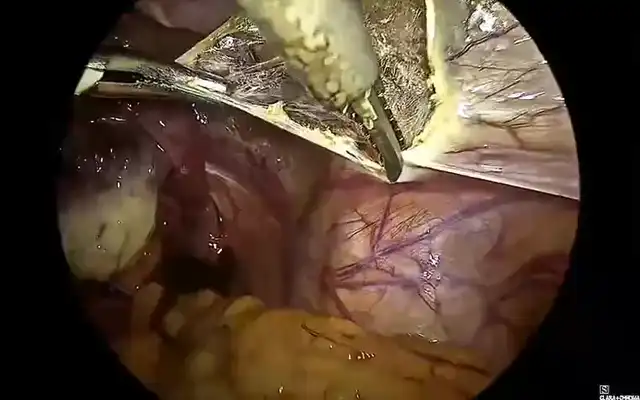
Under general anesthesia, the patient was placed in the dorsal decubitus position. Pneumoperitoneum was established via a trans umbilical incision, and three trocars were inserted using the French technique with additional 5 mm trocar in Palmer’s point. The 5 mm trocar in the right iliac fossa was changed with a 12 mm trocar in order to allow the subsequent insertion of the laparoscopic linear stapler. A panoramic inspection of the abdominal cavity and pelvis was performed. All visible endometriotic lesions involving the peritoneum, ovaries, and posterior compartment were excised. For the intestinal treatment a step-by-step technique was performed:
- Systematic survey: MRI correlation with laparoscopic findings.
- Dissection of the posterior compartment: dissection of avascular spaces and landmarks identifications (Ureterolysis and nerve-sparing dissection of hypogastric plexus). Dissection of the posterior pelvic compartment is performed via a medial-to-lateral approach, preserving adjacent structures.
- Dissection of the rectovaginal space: Opening of rectovaginal space while maintaining the integrity of the rectal and vaginal walls
- Colpotomy and uterine separation: In this case, a hysterectomy was performed, and the colpotomy was used for specimen extraction and to introduce the anvil for the intracorporeal anastomosis.
- Delimitation of the affected segment: Segmental bowel resection is indicated due to transmural infiltration and luminal compromise
- Resection planning: Division of mesocolon close to bowel wall to preserve vascularization and autonomic nerves.
- Preparation if the distal margin: The distal margin is transected with a linear stapler
- Dissection of the proximal margin: the proximal bowel is resected using ultrasonic energy, and the specimen is extracted via the vaginal route.
- Anvil vaginal insertion and fixation to the proximal stump: The anvil is introduced transvaginally, and then secured to the proximal stump with tobacco-pouch technique and barbed suture.
- Colorectal anastomosis: The circular stapler is inserted transanal, ensuring proper alignment, and the anastomosis is completed under direct visualization. Anastomotic integrity is confirmed with pneumatic testing and serosal reinforcement. Colpotomy closure with absorbable sutures.
Discussion
Outcomes and Challenges of Segmental Resection: Laparoscopic segmental resection of the rectosigmoid for DE can achieve excellent symptomatic relief and long-term disease control in appropriately selected patients. Mabrouk et al. reported high rates of pain improvement and low recurrence following complete excision of rectosigmoid endometriotic nodules over a 13-year follow-up (2). Nevertheless, this approach is technically demanding and traditionally requires a small laparotomy for specimen retrieval and anastomosis. The added steps of exteriorizing the bowel and performing a hand-sewn anastomosis prolong operative time and contribute to increased postoperative morbidity. Even a mini-Pfannenstiel incision can lead to significant incisional pain, higher wound complication rates (infection or dehiscence), hernia formation, and bleeding at the extraction site. Thus, despite its therapeutic efficacy, conventional segmental resection carries non-negligible risks linked to the abdominal incision and extended operation time.
Advantages of Total Intracorporeal Anastomosis (TICA): TICA with NOSE has emerged as a promising alternative to minimize the morbidity associated with traditional techniques. Early exploratory studies demonstrated the feasibility of avoiding any laparotomy during DE bowel resection by retrieving specimens trans-anal or trans-vaginally. Akladios et al. were among the first to show that a NOSE approach in endometriosis could be achieved without increasing complication rates, underlining its safety as compared to the conventional mini-laparotomy method (5). More recent series have reinforced that a fully laparoscopic resection with intracorporeal anastomosis is at least as effective as the standard approach while conferring distinct benefits. Notably, preliminary reports suggest that avoiding a mini-laparotomy leads to less postoperative pain and fewer wound-related problems, along with faster recovery of bowel function and shorter hospitalization. In the first direct comparison of TICA versus conventional anastomosis after extraction, Ianieri et al. found that both techniques yielded significant improvements in gastrointestinal symptoms and quality-of-life scores, with no increase in surgical complications in the TICA group (4). By maintaining a purely laparoscopic field, TICA also facilitates a nerve-sparing surgical strategy to preserve pelvic autonomic neurovascular structures. This nerve-sparing approach is crucial for reducing long-term sequelae such as bladder atony or bowel dysfunction, thereby potentially improving postoperative genitourinary and gastrointestinal quality of life for patients with DE. Overall, TICA enables the surgeon to complete the resection and anastomosis entirely within the abdominal cavity, avoiding the morbidity of an abdominal incision while ensuring adequate disease removal.
Purse-String Intracorporeal Anastomosis Technique: A key technical refinement to optimize the safety of intracorporeal anastomosis is the use of a laparoscopic purse-string suture to secure the anvil in the proximal colon. This technique, as described by Seracchioli et al., helps stabilize the anvil head and ensures a uniform tissue cuff for the circular anastomosis (7). By pursing the colonic lumen tightly around the anvil shaft, one can eliminate “dog ear” deformities – small corners of tissue that might otherwise be trapped outside the stapler doughnuts – thereby improving the seal integrity of the anastomosis. This method reduces the risk of anastomotic leakage by achieving a symmetric, well-perfused anastomotic ring. In our experience, the purse-string suture also streamlines the intracorporeal anastomotic step by maintaining the anvil in correct position while the circular stapler is aligned transanally. These technical nuances underscore that advanced suturing skills and standardized steps can enhance anastomotic security even when performed totally laparoscopically.
Role of NOSE and Future Directions: NOSE techniques – including transvaginal and transanal routes – have gained popularity in colorectal endometriosis surgery as a means to avoid abdominal incisions. Accumulating evidence indicates that NOSE can be adopted without compromising surgical outcomes. A recent systematic review and meta-analysis by Kar et al. compared NOSE to mini-laparotomy for specimen retrieval in endometriosis bowel resections and found no differences in major complication rates (approximately 3–5% in both groups) (6). Importantly, NOSE was associated with a modest but significant reduction in hospital stay, reflecting enhanced recovery, and a trend toward reduced intraoperative blood loss when the entire procedure was completed laparoscopically. These findings suggest that avoiding even a small laparotomy can positively impact patient recovery. However, the review also highlighted the heterogeneity in patient selection and operative techniques across studies and noted that only one randomized controlled trial was available among the data. Thus, while NOSE appears to be a safe and potentially beneficial alternative to traditional specimen retrieval, its definitive advantages remain to be validated. Further standardization of the NOSE procedure and high-quality randomized trials are needed to confirm the long-term benefits and to establish clear guidelines on patient eligibility. As the adoption of TICA with NOSE grows, ongoing evaluation of functional outcomes (bowel function, continence, sexual function) will be critical to ensure that we are truly improving quality of life and not just operative metrics.
Standardized 10-Step Protocol for TICA with NOSE in DE: Given the complexity of combining advanced laparoscopic resection and NOSE, a structured approach is essential to reproducibly achieve optimal results. This video article introduces a step-by-step, standardized 10-step protocol for laparoscopic segmental bowel resection in DE with totally intracorporeal anastomosis and transvaginal specimen extraction. By delineating the procedure into ten defined steps – from patient and trocars positioning, through nerve-sparing rectal dissection, to intracorporeal anastomotic creation and specimen removal – we aim to streamline the learning curve for this technique. Standardization will facilitate training, improve consistency between surgeons, and ultimately enhance patient outcomes. In summary, adopting TICA with NOSE for rectosigmoid endometriosis can maintain the proven efficacy of segmental resection while minimizing invasiveness. Emphasis on technical details such as the identification of landmarks, nerve-sparing, purse-string for the anastomosis and adherence to a standardized protocol can ensure that the approach is executed safely. This advancement underscores the continuing evolution of minimally invasive gynecologic surgery, striving to improve the balance between radicality of endometriosis excision and the quality of postoperative recovery.
Conclusion
The surgical management of rectosigmoid DE presents a significant technical challenge, particularly when segmental bowel resection is required. Although laparoscopic segmental resection with intracorporeal anastomosis and NOSE has emerged as a promising minimally invasive strategy, its widespread adoption is limited by the steep learning curve and the variability in surgical technique across centers. By proposing a standardized 10-step protocol for TICA with NOSE, this study aims to provide a reproducible surgical roadmap that prioritizes safety, anatomical preservation, and functional outcomes. Structured protocols not only improve consistency and surgical performance but also facilitate teaching, training, and knowledge transfer within advanced endometriosis centers. As surgical techniques continue to evolve, standardization becomes essential to democratize access to high-quality care and to ensure that the benefits of minimally invasive radical excision are available to a broader patient population.